
Film culture / research notes

Trivia & Essays

Cinema beyond the wager.

Film Mosaic is an independent English-language luxury film review, cinematic analysis, and media guide portal. This archive follows the hidden labour, real places, and cultural ideas behind casino cinema, high-stakes gambling plots, crime thrillers, heist narratives, psychological drama, and cinema culture. We look at how scripts, production design, editing, performance, locations, and research construct tension, status, deception, and consequence—treating cinematic gambling as a storytelling device, never a recommendation for real-world activity.

Check NZ availability

Availability changes. Check streaming, rental, purchase, and cinema listings independently through JustWatch NZ.

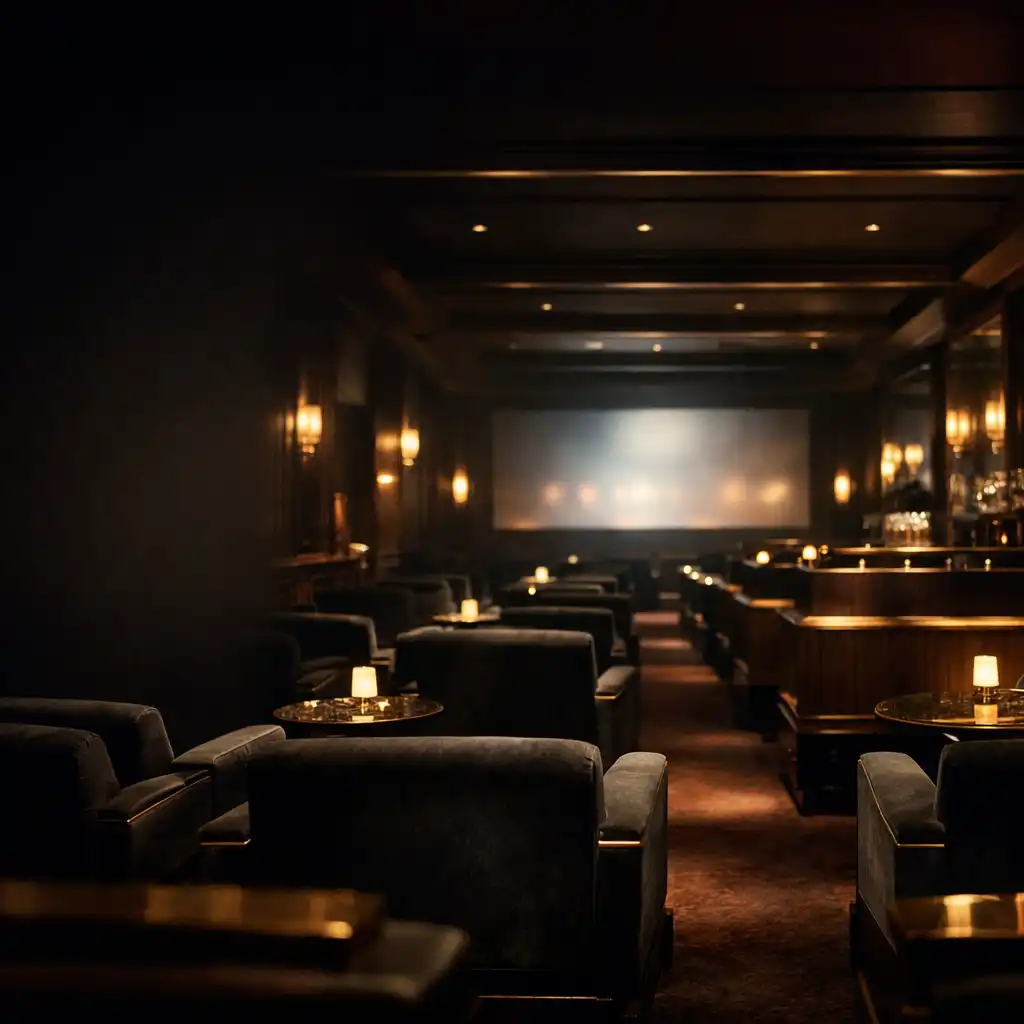
An empty refined screening-room-inspired salon with dark seating, timber walls, brass details, and a distant projection glow.

Archive lenses

What the archive investigates

These are the recurring questions behind our notes: how an image earns its atmosphere, what a setting asks a character to perform, and where a film’s apparent glamour starts to reveal its pressure.

01

Place

Real places, screen myths

Las Vegas and Monte Carlo can become compressed cinematic shorthand for aspiration, surveillance, secrecy, and performance. Our location reading separates a city’s lived reality from the persona built through establishing shots, architecture, costume, and sound. The point is visual and cultural analysis, useful to New Zealand and international cinephiles alike—not unsupported claims about where a film was made.
02

Craft

Production craft under pressure

Production design, lighting, sound, costume, and editorial rhythm create a sense of stakes long before a plot resolves. We trace how a narrow pool of light, an immaculate cuff, a distant room tone, or an abruptly empty corridor can signal wealth, isolation, concealment, or instability. These notes keep attention on filmmaking process and invite viewers to notice concrete screen details.

03

Structure

Scripts, masks, and moral consequence

Writers use bargains, bluffs, debts, double lives, and withheld information to test character without romanticising destructive behaviour. Across crime thrillers, heist narratives, and psychological drama, we examine structure, dialogue, point of view, and reversals. Here, risk is a dramatic theme: a way to ask whose motives remain hidden, and who must live with the consequence.

04

Image

The image of wealth

Luxury cinema deserves a critical reading. Polished rooms, tailored wardrobes, private tables, and panoramic architecture can reveal class performance, exclusion, fragility, and desire as clearly as they communicate expense. We look at framing, texture, and scale to see how spectacle may seduce the eye while the story remains sceptical of the power it appears to display.

Featured essay 8 minute read

The architecture of a bluff

A bluff on screen is rarely only a private calculation. It is a staged performance for characters, camera, and audience alike. This featured essay follows misdirection through blocking, cut timing, reaction shots, and carefully selective access to information. In high-stakes plots, crime stories, heist narratives, and psychological dramas, the most telling deception often lies in the frame’s organisation: who can see an exit, who is held at a distance, and what the edit lets us understand a moment too late.

01 / Space

The room as an accomplice

Spatial design can turn a glamorous interior into a machine for observation, concealment, hierarchy, and dramatic delay. Entrances, sightlines, reflective surfaces, distance, and crowd density determine who appears exposed and who seems protected. A luxurious room may look expansive, yet its repeated thresholds and watchful faces can make a character’s isolation more visible. Set design becomes a narrative instrument, arranging pressure before anyone names it.

02 / Edit

Editing the withheld fact

Suspense often arrives through the decision to delay a hand, a glance, a ledger, a doorway, or the consequence of an off-screen choice. The question is not game mechanics but information control: what viewers are allowed to know, and whose uncertainty they are asked to inhabit. A cut can shift allegiance with almost no dialogue, making the missing image do the work of an explanation.

03 / Aftermath

The cost after the reveal

The strongest genre films do not end at the reveal. They let new knowledge alter relationships, self-image, and moral consequence. That aftermath draws psychological drama into contact with the thriller: a character has to account for the role they played, not merely escape a spectacular moment. The result is a richer form of tension, one measured by damaged trust and altered perspective rather than display alone.

Explore plot breakdowns
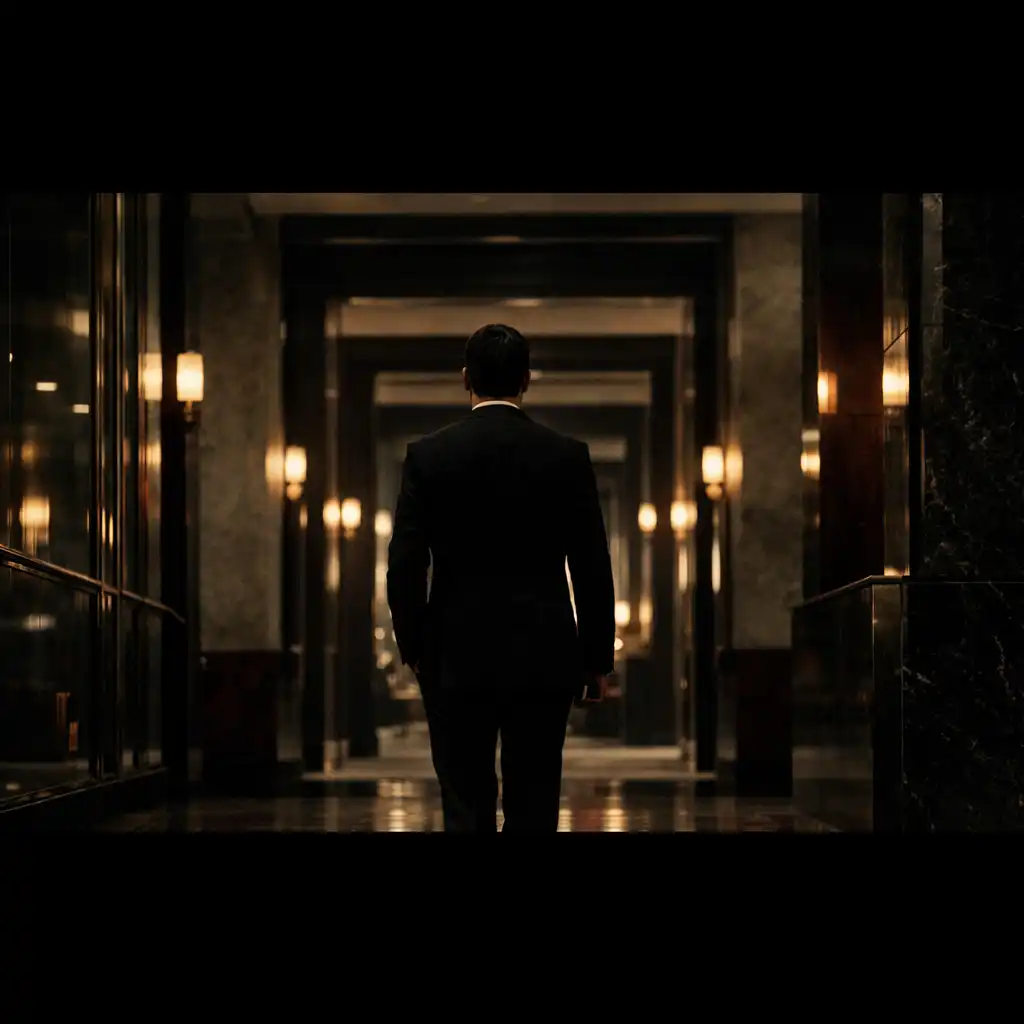
A solitary sharply dressed figure seen from behind in a dim grand corridor with polished stone, glass, and repeated doorways.

Production notes

What audiences rarely see

Production trivia becomes more useful when it helps a viewer recognise the decisions that carry character, atmosphere, and story through a scene.

Note 01 Continuity

Continuity as dramatic evidence

Recurring objects, costume changes, prop placement, and light direction can quietly track a character’s control, fatigue, or changing social position across a sequence. A close reading does not need to turn every detail into a verified secret. Instead, it can compare still frames, notice patterns, and ask how an apparently small visual choice supports character and visual storytelling. That distinction keeps curiosity attentive without mistaking speculation for fact.

Note 02 Sound

Sound before spectacle

Room tone, distant crowd texture, footsteps, glassware, silence, and music cues can make a supposedly glamorous space feel unstable or emotionally airless. Sound design is an interpretive layer: it decides whether a room feels crowded, insulated, exposed, or strangely vacant. Revisit a sequence with headphones or a considered home-cinema setup and notice how the soundtrack shapes attention long before an image announces its importance.

Note 03 Realism

Practical detail versus cinematic compression

Films often simplify procedures, geography, timing, and professional routines to preserve pace, character clarity, or thematic force. A realism audit is not nit-picking; it asks what that compression changes. Does a shortened timeline sharpen a character’s panic? Does an impossible route make a city feel mythic? Comparing effect with plausibility helps viewers see why a scene works, and where its screen logic deliberately departs from ordinary life. Read technical realism audits.

Place study

Places that became cinematic shorthand

Real places become screen language through repetition, selection, and omission. These readings consider cultural images rather than travel advice or claims about individual productions.

Screen language, not travel advice

Las Vegas: scale, glare, and managed fantasy

Cinema often uses Las Vegas as shorthand for spectacle, excess, performance, hospitality systems, surveillance, and the uneasy gap between public glamour and private pressure. It is a real city with many lives beyond that image. On screen, broad boulevards, reflective interiors, artificial daylight, and layers of signage can become visual tools for showing a character swallowed by scale, or trying to control an environment designed to keep attention moving.

Monte Carlo: ritual, restraint, and the close-up

Monte Carlo often suggests ceremonial wealth, polished surfaces, formality, and social scrutiny, communicated through detail rather than an enormous urban field. Gloves, thresholds, chandeliers, formal dress, and controlled movement can make a room feel governed by unspoken rules. This is an interpretive cinematic association, not a guide to real-world gambling. Its screen image is especially useful for reading character performance: who knows the ritual, who only imitates it, and who is watched while doing so.

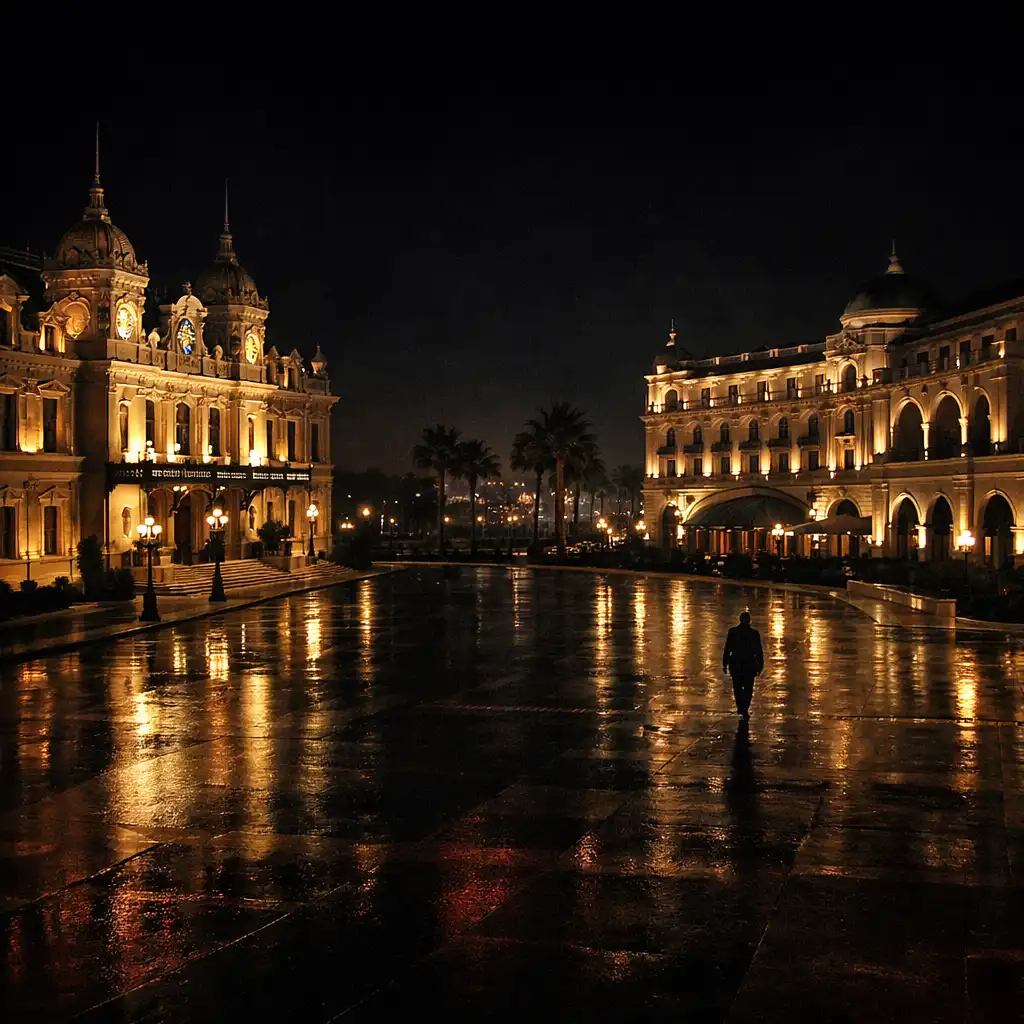
An illuminated stone façade and empty wet forecourt at night, with distant palms and one anonymous pedestrian in the background.
Illustrative image A visual study of cinematic architecture and atmosphere, not a claim about a particular venue, location, or production.

Critical framework

Essays on wealth, risk, and spectacle

Film Mosaic reads the genre as a set of images and consequences: what a room promises, what a camera withholds, and what remains after the display has done its work.

01

Wealth is a costume

Screen wealth is often communicated through behaviour, access, framing, and who is permitted to wait rather than simply through expensive objects. Tailoring, silence, spatial privilege, and service rituals all act as narrative signals. The luxury image can expose insecurity as much as power, especially when a character’s apparent ease depends on others staying invisible.

02

Risk is a point of view

A film’s tension changes according to who knows the danger, who bears the consequence, and whose choices the camera treats as legible. Point of view, pacing, and withheld information shape uncertainty across thrillers, crime stories, and psychological drama. The most revealing question is often not what might happen, but who is left to understand it first.

03

Spectacle can be an alibi

Visual excess may distract characters and audiences from labour, violence, inequality, or emotional damage. Great films can turn that distraction into part of the critique, using scale, montage, music, and production design to show what the image conceals. We can admire the craft while keeping attention on the costs it places just outside the frame.

Browse essays
The most revealing luxury image is often the one that shows who has nowhere private left to go. Film Mosaic editorial lens

Research desk

Read by method

01Character

Character dossier route

For readers interested in masks, motives, status, and self-invention, our dossiers offer close readings of screen personas and turning points. Follow a character’s performance of confidence, the visual clues that unsettle it, and the moment a carefully managed identity begins to change.

Read dossiers
02Structure

Plot breakdown route

For readers following setup, reversal, concealment, and consequence, this route focuses on narrative and screenplay analysis. It traces how genre cinema arranges expectation without reducing a film to spoilers, keeping attention on structure, perspective, and the pressure placed on a choice.

Study structure
03Criticism

Prestige review route

For readers choosing a film, our critical reviews weigh craft, performance, tone, and lasting impact. They are editorial evaluations rather than promotional rankings, designed to clarify what a film attempts, what it achieves, and which details may reward a closer return.

Read reviews
04NZ guide

Where to watch route

For readers ready to look for a title in New Zealand, availability is changeable. Visit the dedicated guide for context, then check the external JustWatch NZ directory for current streaming, rental, purchase, or cinema listings.

View NZ guide

New Zealand viewing notes

Find the film, then check the listing

Catalogues, cinema sessions, rental windows, and 4K editions change. Film Mosaic offers discovery guidance for New Zealand streaming, rental, purchase, physical-media, and cinema contexts rather than permanent availability claims. Once an essay or review has narrowed your watchlist, use a current third-party listing to confirm where and how a title can be viewed locally.

Open JustWatch NZ

External directory; opens in a new tab.

Editorial standards

Curiosity without the sales pitch

Our archive is designed for readers who want to look more closely at cinema culture while retaining clear boundaries around research, recommendation, and real-world activity.

01

Films first

Film Mosaic examines film form, history, performance, production, and media culture. It does not provide instructions, inducements, or endorsements for real-money gambling. Our interest is in stories, imagery, and craft: how a script constructs a choice, how a room frames a character, and how a film makes consequence visible.

02

Claims need context

Production trivia, technical observations, and real-world references need attribution or a clear analytical frame. We distinguish what can be verified from what can be observed, and avoid invented anecdotes or unsupported certainty. Because availability changes, practical viewing information is checked through third-party sources rather than treated as fixed.

03

Luxury is a subject, not a promise

Film Mosaic studies how cinema stages aspiration, privilege, glamour, and collapse. Its restrained visual setting is editorial, not a lifestyle claim: a private cinema archive rather than a gambling venue. That distinction lets us admire material detail while asking what it means, who it excludes, and what it leaves behind. Thoughtful viewing begins with that second look.

For practical discovery, Film Mosaic may link to the external JustWatch NZ directory ↗. Its listings remain separate from our editorial judgement and are not an endorsement or partnership.

Continue the viewing

Keep watching closely

Return to a film with fresh attention to what the frame reveals: the room, the costume, the cut, the silence, and the consequence after the spectacle. Film Mosaic is here for deeper viewing, critical curiosity, and thoughtful routes into cinema culture—not transaction or hype.

Availability route opens JustWatch NZ in a new tab.